About me
I am a researcher at the Laboratory for Mountain Ecosystems and Societies, INRAE in Grenoble, France.
Research overview
My research explores how anthropogenic and environmental drivers shape plant and multitrophic communities, and how these changes cascade to ecosystem functioning and Nature’s Contributions to People (NCP). A central aim of my work is to bridge the gap between ecological processes - such as biodiversity-ecosystem functioning relationships - and social dimensions of social–ecological systems, including quality of life, equity, and trade-offs among stakeholders.
By combining approaches from community ecology, landscape ecology, and sustainability science, I hope to improve our understanding of how ecosystems can be managed to jointly support biodiversity, ecosystem functioning, and human well-being.
Landscape structure and ecosystem benefits
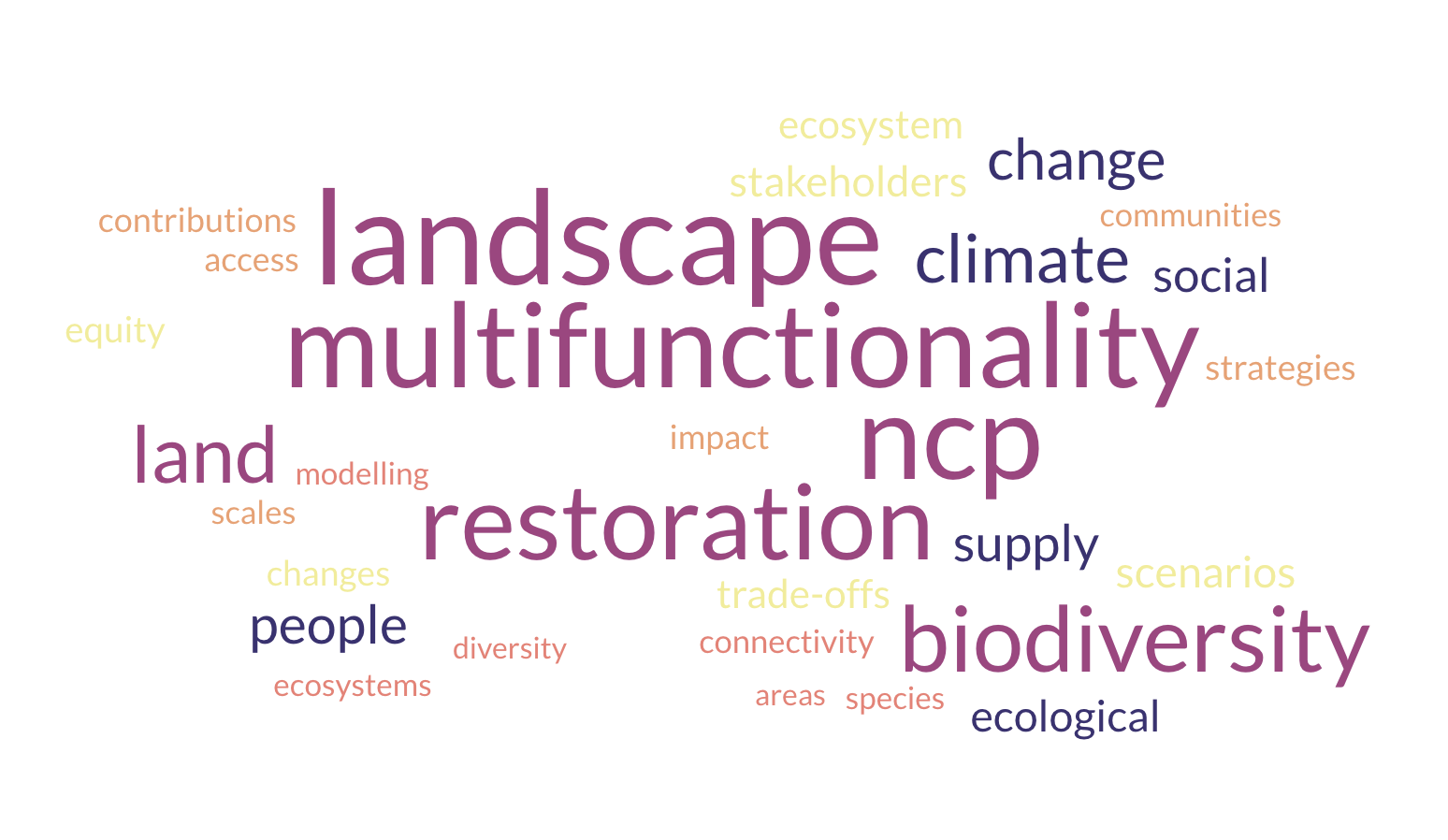
One main focus of my work is understanding how landscape design influences ecosystem multifunctionality. In particular, I focus on the combined effects of landscape composition (i.e. the relative abundance of different land-use types) and landscape configuration (i.e. their spatial arrangement) on multiple NCP.
To address these questions, I use virtual landscape modelling approaches to create in silico experiments in which specific components of landscape structure are systematically manipulated. This allows me to assess how synergies and trade-offs between different NCP emerge at the landscape scale, and how these benefits to people align - or conflict - with biodiversity conservation and landscape connectivity.
Nature, access, and environmental justice
A second focus of my research concerns environmental justice, with particular attention to equity in access to and benefits from nature’s contributions to people. This includes questions of priorities and demand - who needs which NCP, and under what conditions - but also the identification of social, economic, and spatial barriers that shape access to these benefits.
I am especially interested in how socio-demographic differences interact with landscape structure to influence access to NCP, and how landscape planning and management can be leveraged to reduce inequalities and promote more just social–ecological systems.
Functional ecology across ecosystems
In previous research, I have also investigated the mechanisms structuring plant and multi-taxa communities across temporal and spatial scales, using both taxonomic and functional trait–based approaches.
In particular, I aimed to understand how functional strategies shift along environmental and land-use gradients - for example, the transition from “slow”, conservative strategies under low land-use intensity to “fast”, acquisitive strategies under high land-use intensity.